Hours, directions, entrances and the best time to arrive
Palace of Culture and Science visitor guide
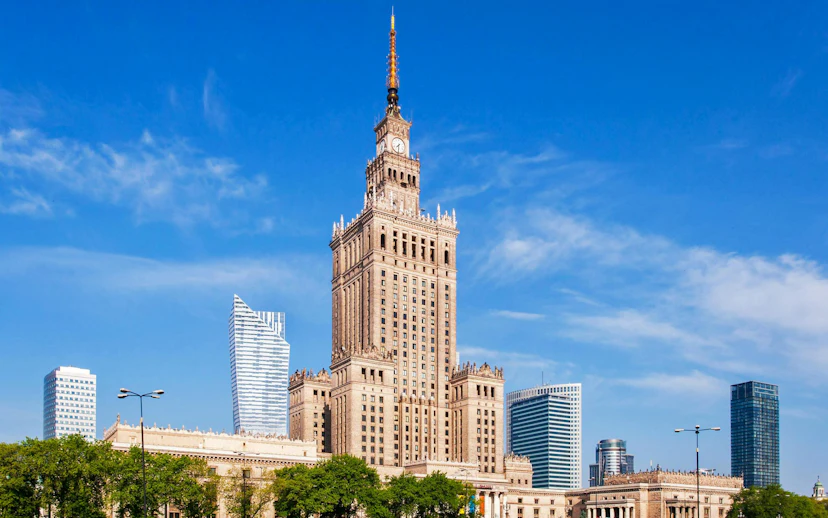
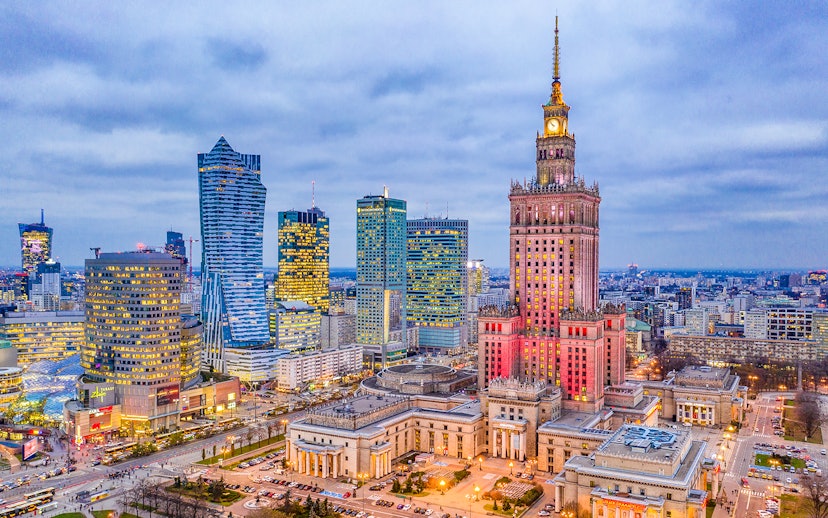
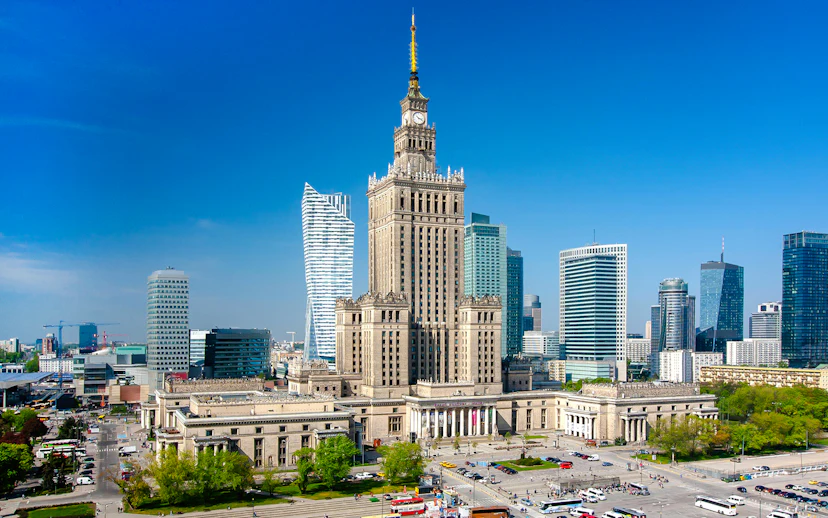
The Palace of Culture and Science is Warsaw’s most recognizable landmark, best known for its 30th-floor observation deck and unmistakable Stalinist-era silhouette. A visit is usually straightforward, but the building is bigger and busier than most people expect because the terrace, museums, theaters, and event spaces all share one complex. The biggest difference between an easy visit and a frustrating one is timing your elevator ride around the sunset rush. This guide covers entry, tickets, timing, and how to move through the building without wasting time.
Quick overview: Palace of Culture and Science at a glance
If you want the skyline view without the usual friction, a little planning pays off here.
- When to visit: Daily, with demand building from late afternoon into evening; weekday mornings are noticeably calmer than Friday sunset and Saturday late afternoon because the terrace is compact and railing space fills quickly.
- Getting in: Standard observation deck entry starts around $7, while Headout also offers skip-the-line entry with observation deck access and an optional English-guided tour, which is the better call on weekends and summer evenings.
- How long to allow: 1–2 hours for most visitors, stretching closer to 2 hours if you add the 31st-floor memorabilia exhibit, linger for photos, or visit one of the museums inside the building.
- What most people miss: The 31st-floor PKiN memorabilia exhibit and the socialist-realist façade sculptures are easy to overlook if you go straight up, take photos, and leave.
- Is a guide worth it? Yes, if you care about the building’s Cold War history and symbolism; if you mainly want the view, the included PDF guidebook on Headout’s skip-the-line ticket is enough.
Jump to what you need
🕒 Where and when to go
🗓️ How much time do you need?
Visit lengths, suggested routes and how to plan around your time
🎟️ Which ticket is right for you?
Compare all entry options, tours and special experiences
🗺️ Getting around
How the building is laid out and the route that makes most sense
🌆 What to see
Old Town, the Vistula River, and Warsaw’s skyline
♿ Facilities and accessibility
Restrooms, lockers, accessibility details and family services
Where and when to go
How do you get to the Palace of Culture and Science?
The Palace sits right in central Warsaw at Plac Defilad, beside Warsaw Central and a short walk from the Śródmieście transit hub.
Plac Defilad 1, 00-901 Warsaw, Poland
→ Open in Google Maps
- Metro: Świętokrzyska station → 5-min walk → use the exits toward Plac Defilad for the most direct approach.
- Train: Warszawa Centralna → 8-min walk → the Palace is the dominant tower directly across the station area.
- Tram: Central downtown stops around Marszałkowska and Aleje Jerozolimskie → 3–7 min walk → easiest if you are already moving between central sights.
- Taxi / rideshare: Drop-off at Plac Defilad or Marszałkowska side → 2–3 min walk → simplest in rain or after dark.
Full getting there guide
Which entrance should you use?
For most visitors, the important thing is not finding the building but finding the correct queue inside it. The observation deck uses the main public entrance, but pre-booked and on-the-day visitors don’t move at the same speed.
- Pre-booked / skip-the-line tickets: For digital ticket holders. Expect a 5–10 min wait during busy summer afternoons and around sunset.
- On-the-day ticket line: For visitors buying at the venue. Expect a 20–40 min wait on weekends, school holidays, and clear-weather evenings.
Full entrances guide
When is the Palace of Culture and Science open?
- Observation deck: Open daily, with hours extending from daytime into the evening depending on season and events.
- Museums, theaters, and cinema: Opening hours vary by venue inside the building.
- Last entry: Arrive at least 30–45 min before the final elevator up to avoid being turned away at the end of the day.
When is it busiest? Friday evenings, Saturday afternoons, and clear-weather sunset windows are the busiest, when the terrace feels most crowded and railing space goes fast.
When should you actually go? Weekday mornings are the easiest time to visit, because tour groups and after-work visitors have not yet built up and you get cleaner sightlines for photos.
How much time do you need?
Which Palace of Culture and Science ticket is best for you
| Ticket type | What's included | Best for | Price range |
|---|---|---|---|
Skip-the-Line Tickets to the Palace of Culture & Science with Observation Deck Access & Optional Guided Tour | Skip-the-line entry + access to the observation deck + Palace of Culture and Science and Warsaw PDF guidebook + optional English-guided tour | A short visit where you want the skyline view without risking the slower on-site ticket line | |
Warsaw Pass with Access to 20+ Attractions | 24/48/72-hour city pass + entry to 20+ attractions + access to the Viewing Terrace 30th Floor + special offers and discounts | A Warsaw itinerary with multiple paid sights where the deck is only one stop among museums, palaces, and other landmarks | |
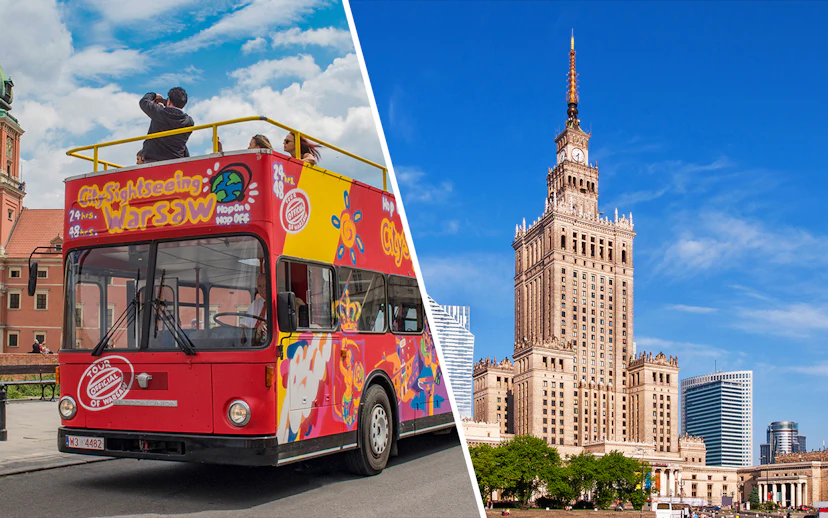
Combo (Save 5%): Warsaw Hop-on hop-off Bus Tour + Warsaw Pass | 24/48/72-hour Hop-On Hop-Off bus tour + Red and Blue routes + audio guide in 10 languages + Warsaw Pass with access to 20+ attractions including the Viewing Terrace 30th Floor | A city break where you want transport and attraction entry bundled, rather than planning each central stop separately |
How do you get around the Palace of Culture and Science?
Layout and route
The Palace is best handled as a vertical landmark rather than a room-by-room museum, and most visitors can cover the key public areas on foot in 1–2 hours. The main public entrance puts you into the central halls first, with the observation deck elevator route as the focal point of the visit.
- Main hall: Grand Stalinist lobby spaces → your bearings point, ticket checks, and elevator access → 10–15 min.
- 30th-floor observation deck: Open-air panoramic terrace and Gothic Hall → the main reason most people come → 30–45 min.
- 31st-floor memorabilia exhibit: PKiN history, original furnishings, uniforms, and artifacts → worth adding if you want more than just the view → 30–45 min.
- Lower-floor museums and venues: Technology, evolution, theaters, and cinema → best added only if one specifically interests you → 30–90 min.
A smart route is to go up first, do your full terrace loop before the railings get crowded, then come back down for the exhibit or museums. Most people make the opposite mistake and linger downstairs until the best light turns into the busiest elevator window.
Maps and navigation tools
- Map: Building directories and venue signage cover the public halls → useful once inside → check the official PKiN site before arrival if you want venue-specific floors.
- Signage: Good enough for the observation deck route, but less intuitive if you are combining the terrace with museums or performance spaces.
- Audio guide / app: Headout’s skip-the-line ticket includes a PDF guidebook → useful for a self-paced deck visit → a live guide adds more value if you want the Cold War history explained.
💡 Pro tip: Go straight to the observation deck first and save the lower floors for later — the skyline only gets more crowded as the day goes on, but the exhibit rooms do not.
Get the Palace of Culture and Science map / audio guide
What can you see from Palace of Culture and Science?

1/4
Old Town and Royal Castle
View type: Historic core
From the terrace, this is the view that gives you the clearest contrast between old Warsaw and the rebuilt modern city around it. Slow down long enough to pick out the denser, lower historic blocks rather than just photographing the far skyline. Most visitors snap one wide shot and move on without isolating the Old Town itself.
Where to find it: The north-facing side of the terrace, looking toward the older, lower-rise part of the city.
The Vistula River and east bank
View type: River corridor
The river view opens up Warsaw in a way street level never does, especially when the light catches the bends of the Vistula and the greener eastern bank beyond. It is worth waiting a minute here instead of treating it as filler between skyline shots. Most people miss how much of the city’s geography suddenly makes sense from this angle.
Where to find it: The east-facing railing, where the river line is easiest to follow through the city.
Central Warsaw’s skyscrapers
View type: Modern skyline
This is the most dramatic urban view from the deck, with glass towers and office blocks crowding the center around you. What makes it interesting is not just height but proximity — you are close enough to read the shape of Warsaw’s post-communist rebuild in one sweep. Many visitors photograph outward only and forget to compare the Palace itself to the newer towers beside it.
Where to find it: The south and south-west sides of the terrace, facing the business district.
Plac Defilad and the Palace façade
View type: Architectural detail
Do not spend the entire visit looking at the horizon. Looking down reveals the scale of Plac Defilad and gives you one of the best angles on the Palace’s socialist-realist sculptural program and monumental massing. This is where the building stops being just a lookout point and starts making sense as a political statement in stone.
Where to find it: Best seen by walking the full perimeter, especially the corners where you can look down along the façade.
Facilities and accessibility
- 🎒 Lockers: Lockers are available on the ground floor, which makes a lighter terrace visit much easier than carrying bulky bags upstairs.
- 🚻 Restrooms: Public restrooms are available inside the building, and it is smarter to use them before taking the elevator up.
- 🍽️ Café: There is a café on the 30th floor, which is convenient for a short drink break but works better as a pause than a full meal stop.
- 🛍️ Bookshops and souvenirs: The building includes bookshops and gift-style browsing options, which are more interesting for architecture and Warsaw-history fans than generic souvenir hunters.
- 🪑 Seating / rest areas: Seating is easiest to find in the public interior spaces and café areas rather than out on the terrace itself.
- ℹ️ Visitor information: A visitor information point on the ground floor is the quickest place to sort out directions if you are combining the terrace with other venues inside the complex.
- ♿ Mobility: Elevators reach the 30th floor, but accessibility is partial because the open-air terrace section includes stairs and is not as easy for wheelchair users as the indoor route up.
- 👁️ Visual impairments: The visit is heavily view-based, so staff assistance at the main lobby is the best move if you want the simplest route to the elevator and public areas.
- 🧠 Cognitive and sensory needs: Weekday mornings are the calmest window, while sunset and school-group hours are the noisiest and most crowded parts of the day.
- 👨👩👧 Families and strollers: The main public route is elevator-friendly, but strollers are easier to manage folded once you reach the upper-level viewing areas and tighter circulation points.
The Palace works well for children who like big views, fast elevators, and a bit of novelty, but the visit is usually best kept fairly short unless you add one of the museums inside.
- 🕐 Time: 45–90 min is realistic with younger children if you focus on the elevator ride, the terrace loop, and 1 extra stop such as the memorabilia exhibit.
- 🏠 Facilities: Restrooms, indoor waiting areas, and the option to add museum spaces make this easier with children than a pure outdoor viewpoint.
- 💡 Engagement: Turn the terrace into a spotting game by picking out the river, the Old Town, and the tallest nearby towers before you head back down.
- 🎒 Logistics: Bring a light extra layer even in warmer months, because the terrace feels windier and cooler than street level.
- 📍 After your visit: Złote Tarasy is a short walk away and is an easy fallback for snacks, rest, and a low-effort reset after the deck.
Rules and restrictions
What you need to know before you go
- Entry requirement: Pre-booked digital tickets are the easiest option here, especially for the observation deck, because on-site lines build fastest in the late afternoon and at sunset.
- Bag policy: Travel light and use the ground-floor lockers if needed, because bulky bags make a short terrace visit slower and more annoying than it needs to be.
- Re-entry policy: Treat the deck as one continuous visit, because the smoothest plan is to use restrooms, sort bags, and decide your route before heading up.
Not allowed
- 🚫 Food and drink: Food and full drinks are best kept to the café and public interior areas rather than the terrace edge.
- 🚬 Smoking and vaping: Smoking and vaping are not appropriate inside the building and should be assumed to be restricted to designated exterior areas only.
- 🖐️ Climbing or leaning on barriers: Do not climb, sit on, or lean over terrace barriers, because the deck is exposed and can be very windy.
Photography
Photography is one of the main reasons to visit, and photos are generally fine on the observation deck and in the Palace’s public areas. The distinction matters more once you move into theaters, temporary exhibitions, or performances inside the complex, where flash, tripods, selfie sticks, or video recording may be restricted. Check signs at each venue entrance rather than assuming the whole building follows the same rule.
Good to know
- Wind: The terrace can feel much colder and windier than street level, so even a sunny day may need an extra layer.
- Timing: If you arrive just before sunset without a pre-booked ticket, you may spend the best light in the slower on-site queue instead of on the deck.
Practical tips
- Booking and arrival: Book sunset or weekend visits a few days ahead if you want the least friction, because those are the slots most likely to turn a simple deck stop into a queue-heavy one.
- Pacing: Go up first and do the full terrace circuit before you look at anything else inside, because the view gets more crowded as the day goes on while the indoor exhibit spaces stay manageable.
- Crowd management: A weekday morning visit usually feels easiest here, not because the building is empty, but because you avoid the overlap of school groups, after-work visitors, and sunset photographers.
- What to bring or leave behind: Bring a light layer and keep your bag small; the terrace is exposed, windy, and much more enjoyable when you are not juggling extra stuff.
- Photos: If you want clean skyline shots, do one full loop for orientation and then come back to the best side, because most people stop at the first opening and create their own crowd bottleneck.
- Food and drink: Use the 30th-floor café for a short break, not as your main meal plan; if you want a proper sit-down lunch or dinner, eat before or after the visit in central Warsaw.
- Make it more than a viewpoint: Add the 31st-floor memorabilia exhibit if you have another 30–45 min, because it gives the building context that the terrace alone does not.
What else is worth visiting nearby?
Commonly paired: Old Town Warsaw
Distance: 2.5km — about 25 min on foot or 10–15 min by transit
Why people combine them: The pairing works because the Palace gives you the skyline first, then the Old Town lets you walk the rebuilt historic core you were just looking at from above.
Book / Learn more
Commonly paired: Saxon Garden
Distance: 1.3km — about 15–18 min on foot
Why people combine them: This is an easy low-effort add-on if you want a breather between central sights, especially after a busy terrace visit or before heading toward the Old Town.
Book / Learn more
Also nearby
Zachęta National Gallery of Art
Distance: 1.2km — about 15 min on foot
Worth knowing: It is a strong nearby stop if you want contemporary Polish art after the Palace’s heavy historical atmosphere.
Warsaw Uprising Museum
Distance: 2.2km — about 10 min by taxi or 25–30 min by transit
Worth knowing: It is not the closest stop, but it pairs well if your Warsaw day is already focused on 20th-century history rather than just skyline views.
Eat, shop and stay near Palace of Culture and Science
- On-site: The 30th-floor café is good for a coffee or quick drink with a view, but it works better as a convenience stop than as a destination meal.
- Złote Tarasy food hall (5-min walk, ul. Złota 59): Good variety, easy with kids, and the simplest fallback if your group cannot agree on 1 cuisine.
- AiOLI inspired by Warsaw (12-min walk, ul. Świętokrzyska 18): Lively all-day option that works well before an evening terrace visit if you want something more substantial.
- Charlotte Menora (10-min walk, ul. Grzybowska 2): Best for coffee, breakfast, or a lighter stop before heading into the Palace rather than after the sunset rush.
- 💡 Pro tip: If you want the terrace at its best light, eat first and go up afterward — sunset is the worst time to still be deciding where to grab dinner.
- PKiN bookshops: Best for architecture, city-history, and culture titles, and more worthwhile than generic fridge-magnet shopping.
- Złote Tarasy: Large nearby mall for practical shopping, snacks, and easy post-visit browsing when you do not want another museum stop.
Yes, if your priority is convenience. The area around the Palace is one of the easiest bases in Warsaw for short trips because you can walk to major transport links, central sights, and plenty of food options, but it feels more functional than atmospheric. If you want charm over convenience, this would not be the most memorable part of the city to sleep in.
- Price point: Mostly mid-range to upper-mid-range business-style hotels, with a few cheaper chain options if you book early.
- Best for: Short stays, rail arrivals, and travelers who want simple city logistics rather than a neighborhood with lots of evening character.
- Consider instead: Old Town for postcard atmosphere, or Powiśle for a more local, food-and-riverfront feel if you are staying longer than 2 nights.
Frequently asked questions about visiting Palace of Culture and Science
Most visits take 1–2 hours. That is enough time for the 30th-floor terrace, a full walk around the deck, and a short pause for photos or a café stop. If you add the 31st-floor memorabilia exhibit or 1 of the museums inside the building, plan closer to 2–2.5 hours.
No, but it is usually the better move. You can buy tickets on-site, but late afternoons, weekends, and sunset windows are when the slower ticket line becomes most frustrating. Pre-booking is especially useful if the observation deck is your main reason for coming rather than a spontaneous stop.
Yes, especially on weekends, summer afternoons, and clear-weather evenings. The view itself is quick and easy, so losing 20–40 min in the on-site line is a poor trade. If you are visiting at a quieter weekday morning slot, standard entry is less of a compromise.
Arrive about 15 min early. That gives you enough time to find the correct entrance, sort bags, and avoid missing the smoother pre-booked flow. If you are aiming for sunset, build in a little extra margin, because that is when the building feels busiest.
Yes, but a small bag is much easier than a large one. The visit works best when you travel light, and lockers are available on the ground floor if you do not want to carry extra gear upstairs. Bulky bags make a short terrace-focused visit slower than it needs to be.
Yes, photos are one of the main reasons to visit. Photography is generally fine on the observation deck and in public areas of the building, but rules can tighten inside theaters, temporary exhibitions, and live performances. If you move beyond the terrace, check signs at the individual venue entrance.
Yes, and it works well for groups if you time it properly. The building is easy to find, centrally located, and simple to combine with other Warsaw sights. The main thing to avoid is arriving together at peak sunset without pre-booked entry, because that is when waiting and regrouping get slow.
Yes, especially for children who like fast elevators and big city views. The visit is short enough to hold attention, and you can extend it with the museums inside if you need more than just the terrace. Most families do best with a 45–90 min visit rather than trying to fill half a day here.
Partly. Elevators make the main route to the upper level manageable, but the open-air terrace access is not fully step-free and can be harder to navigate. It is a better fit for visitors who want the indoor route and views than for anyone needing a completely barrier-free terrace experience.
Yes. There is a café on the 30th floor for a quick break, and the surrounding central Warsaw area gives you plenty of better full-meal options within a 5–15 min walk. If you are planning a sunset visit, it is smarter to eat before you go up.
Weekday late morning gives you the easiest balance of clear views and lighter crowding. Sunset is the most dramatic time visually, but it is also the most crowded and queue-prone. If photos matter more than atmosphere, quieter daylight hours are often the better call.
You can still visit, but the value drops if visibility is poor. Low cloud, rain, or haze can flatten the skyline and make the terrace less rewarding, while strong wind is more noticeable up top than at street level. Clear-weather days are much better if the panorama is your main priority.